

Executive insight: Conversion
Turn more qualified demand into confident, profitable orders.
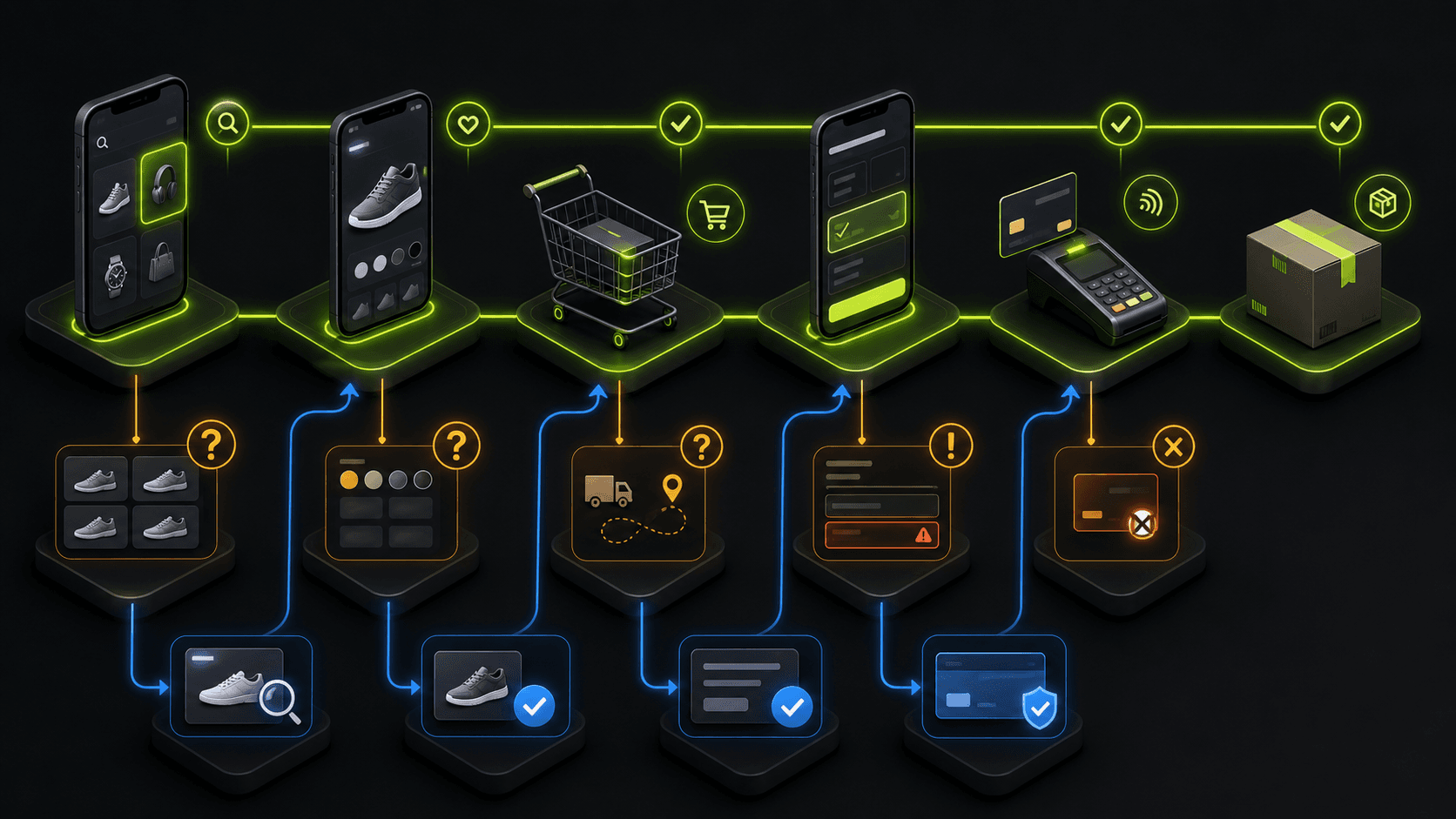
Conversion is not a collection of page tweaks. It is the commercial result of customer confidence, product clarity, price and availability, delivery promise, payment success, and a low-friction path to purchase. Leadership should manage it as a cross-functional revenue system.
- Pain points
- 3
- Decision steps
- 4
- Scorecard measures
- 4
The executive question
Where is qualified demand failing to become profitable revenue?
What is at stake.
- Acquisition spend loses value when high-intent customers cannot complete.
- Average conversion can hide large losses by device, market, payment type, or customer cohort.
- Short-term uplift is not valuable when it increases returns, discounts, or unprofitable orders.
The commercial problem is larger than the functional symptom.
Revenue: CMO · CCO
Paid demand is leaking after acquisition
The business pays to create intent, then loses it to unclear product information, delivery surprises, checkout friction, or payment failure.
Decision quality: CEO · CMO
The average hides the loss
A blended conversion rate conceals material gaps by mobile device, market, category, traffic source, payment method, and customer type.
Margin: CFO · CMO
Uplift can destroy contribution
Discount-led conversion gains may produce more returns, lower-quality orders, and customers who never buy again.
What a 0.3 percentage-point conversion improvement can mean
The model isolates qualified traffic and contribution. It is deliberately not a universal benchmark; leadership should replace traffic, conversion, order value, margin, and return assumptions.
- Qualified visits / month
- 3.2M
- Sessions with meaningful product intent
- Current conversion
- 2.4%
- 76,800 monthly orders
- Average order value
- $95
- Before returns and variable costs
- Contribution rate
- 38%
- After direct commercial costs
- Current monthly revenue$7.30M
- Recovered orders+9,600
- Incremental revenue+$912K
- Annual contribution+$4.16M
Executive use: validate the assumptions with Finance, then use the model to agree the accountable owner, investment ceiling, target outcome, and evidence required to release the next stage of funding.
Translate the issue into outcomes leadership can govern.
High-intent journey completion
Demand capture
Recover intent already paid for by resolving the points where customers hesitate, fail, or abandon.
Contribution per acquired visitor
Acquisition efficiency
Improve the revenue produced by existing traffic before buying additional reach.
Contribution after discounts, returns, and fulfillment
Margin quality
Prioritize changes that improve profitable orders rather than discount-dependent volume.
Pre-purchase contacts, cancellations, and returns
Customer confidence
Make product choice, availability, delivery, returns, and payment consequences clear before commitment.
Move from concern to a governed investment decision.
01 · Define valuable conversion
Which completed orders create durable contribution?
Pair purchase completion with margin, cancellation, return, and repeat behavior.
02 · Locate lost intent
Which customers are trying, but failing, to buy?
Segment by intent, device, market, product, payment, availability, and fulfillment promise.
03 · Resolve the cause
Is the barrier confidence, capability, price, or execution?
Assign each material loss to a named commercial or operational owner.
04 · Prove incrementality
Did the change create new profitable orders?
Use controlled evidence and monitor downstream margin, returns, service, and retention.
Measure the commercial condition, not the volume of activity.
| Measure | What it tells leadership | Early warning |
|---|---|---|
| Qualified conversion | Purchase rate among customers with clear intent | Traffic grows while completed high-intent journeys decline |
| Checkout completion | Ability to complete after checkout begins | Loss clusters around delivery, payment, or account requirements |
| Contribution per visitor | Commercial value of each visit after variable costs | Conversion rises while contribution falls |
| Failure and abandonment | Preventable revenue loss at decisive moments | Teams report different causes from separate data sources |
Use the meeting to make choices, not simply inspect reporting.
- How much qualified demand did we lose last quarter, and why?
- Which customer segment has the largest profitable upside?
- Are we optimizing purchase completion or durable contribution?
- Who owns each of the three largest barriers to purchase?
Move from insight to the relevant operating path.
Turn the executive question into an evidence-led roadmap.
Bring the strategic priority, current performance, constraints, affected teams, and decisions already in motion. We will frame the commercial exposure, ownership, measures, and next investable step.