

Executive insight: Architecture
Make commerce architecture a business choice about speed, control, and optionality.
Architecture determines how safely the company can change: launch a market, add a brand, replace a supplier, integrate an acquisition, or recover from disruption. Senior leaders do not need to choose technical components; they do need to decide where the business requires control, reuse, independence, and evidence.
- Pain points
- 3
- Decision steps
- 4
- Scorecard measures
- 4
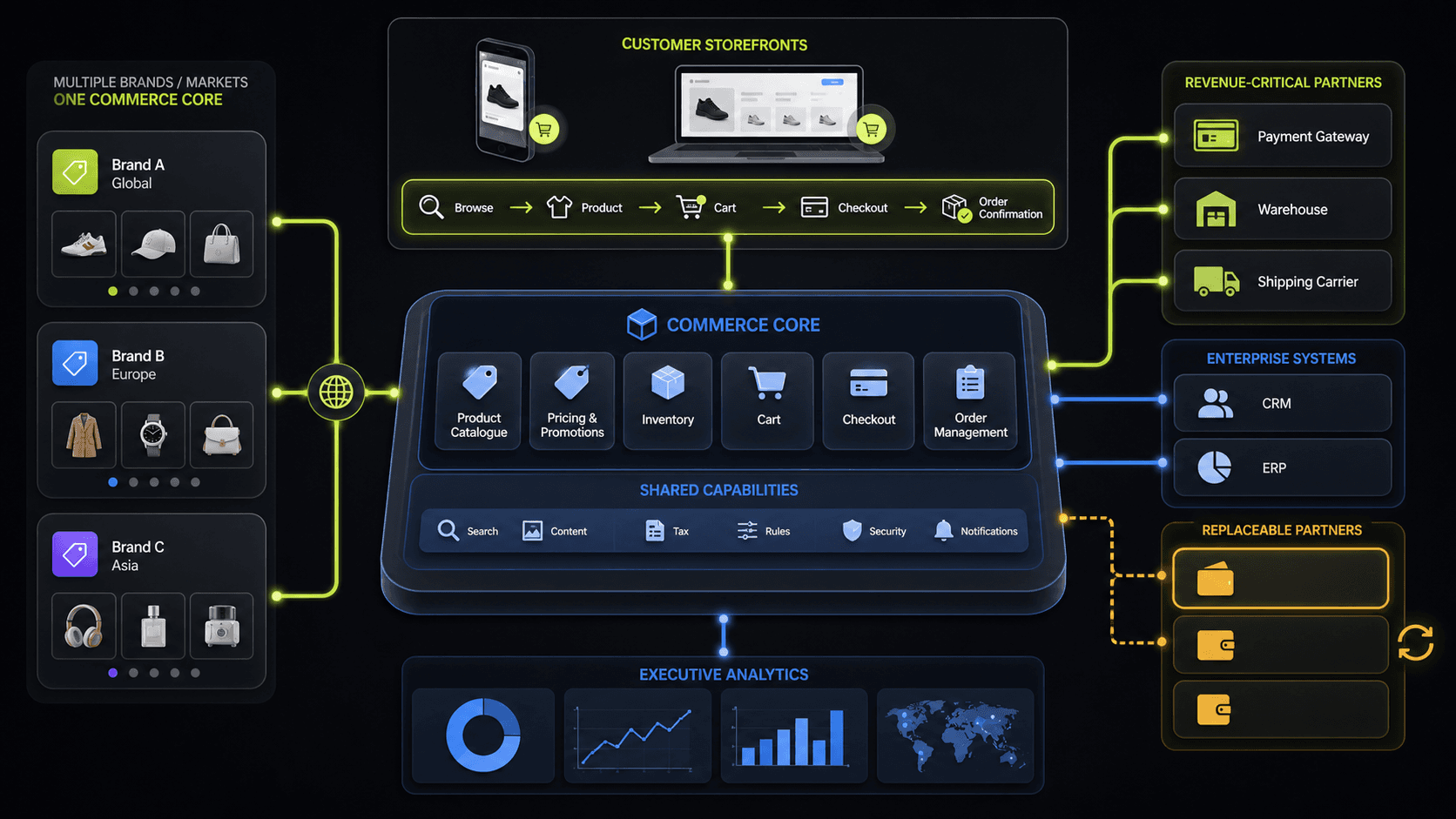
The executive question
Will today’s platform choices accelerate the strategy, or narrow our future options?
What is at stake.
- A platform can be stable yet make every strategic change slow and expensive.
- Unclear ownership turns ordinary change into cross-company coordination.
- Optionality has value when markets, partners, regulation, and customer expectations move.
The commercial problem is larger than the functional symptom.
Growth: CEO · CTO
Strategy moves faster than the platform
Market launches, business-model changes, and acquisitions wait because ordinary commercial changes touch too many systems and teams.
Enterprise risk: CFO · CTO
The company cannot price dependency
Critical revenue may depend on one platform, supplier, integration, or individual without a tested exit or continuity path.
Capital efficiency: CFO · COO
Change spend produces little reuse
The same catalogue, pricing, checkout, integration, and reporting capabilities are rebuilt for each brand or channel.
The annual cost of architecture that makes every change cross-functional
A portfolio-level investment model. Replace initiative count, team effort, delay, revenue timing, remediation, and supplier concentration with the company’s actual change ledger.
- Material changes / year
- 40
- Launches, integrations, and journey changes
- Require broad coordination
- 65%
- Four or more systems or teams
- Annual change budget
- $2.8M
- Excluding run and license cost
- New-market lead time
- 7 months
- Approval to reliable trading
- Change investment$2.8M
- Constraint remediation−$1.1M
- Delay exposure−$2.4M
- Reusable capacity+$1.6M
Executive use: validate the assumptions with Finance, then use the model to agree the accountable owner, investment ceiling, target outcome, and evidence required to release the next stage of funding.
Translate the issue into outcomes leadership can govern.
Lead time for material change
Strategic speed
Shorten the path from commercial decision to a safe customer-facing change.
Change budget spent on legacy constraint
Investment control
Direct spend toward reusable capability and away from repeated remediation.
Revenue locked to a single supplier boundary
Vendor optionality
Replace or add capabilities without rebuilding the entire customer and operating journey.
Business impact of a component or partner failure
Continuity and risk
Contain failures and protect critical trading, data, and operational responsibilities.
Move from concern to a governed investment decision.
01 · Start with strategy
Which business changes must become easier over the next three years?
Name priority markets, brands, channels, acquisitions, models, and customer promises.
02 · Decide control
Where does ownership create competitive or risk value?
Separate differentiating capabilities from those best sourced as reliable commodities.
03 · Design boundaries
What must change independently without disrupting trade?
Align business ownership, data authority, supplier accountability, and investment boundaries.
04 · Govern evolution
How will architecture remain connected to commercial priorities?
Review lead time, reuse, risk, cost, and decision debt, not a technical diagram alone.
Measure the commercial condition, not the volume of activity.
| Measure | What it tells leadership | Early warning |
|---|---|---|
| Change lead time | Speed from approved decision to reliable outcome | Most time is spent coordinating dependencies |
| Change concentration | How many teams and systems ordinary change touches | Small commercial changes require broad releases |
| Reuse across growth units | Leverage gained across brands, markets, and channels | Each launch rebuilds the same foundations |
| Exit and recovery readiness | Ability to contain failure or change a supplier | Critical revenue has no practical alternative path |
Use the meeting to make choices, not simply inspect reporting.
- Which strategic move is hardest because of the current platform?
- Where are we paying repeatedly for the same capability?
- What must the company own, and what should it be free to replace?
- Which architecture risk has a material revenue or regulatory consequence?
Move from insight to the relevant operating path.
Turn the executive question into an evidence-led roadmap.
Bring the strategic priority, current performance, constraints, affected teams, and decisions already in motion. We will frame the commercial exposure, ownership, measures, and next investable step.